
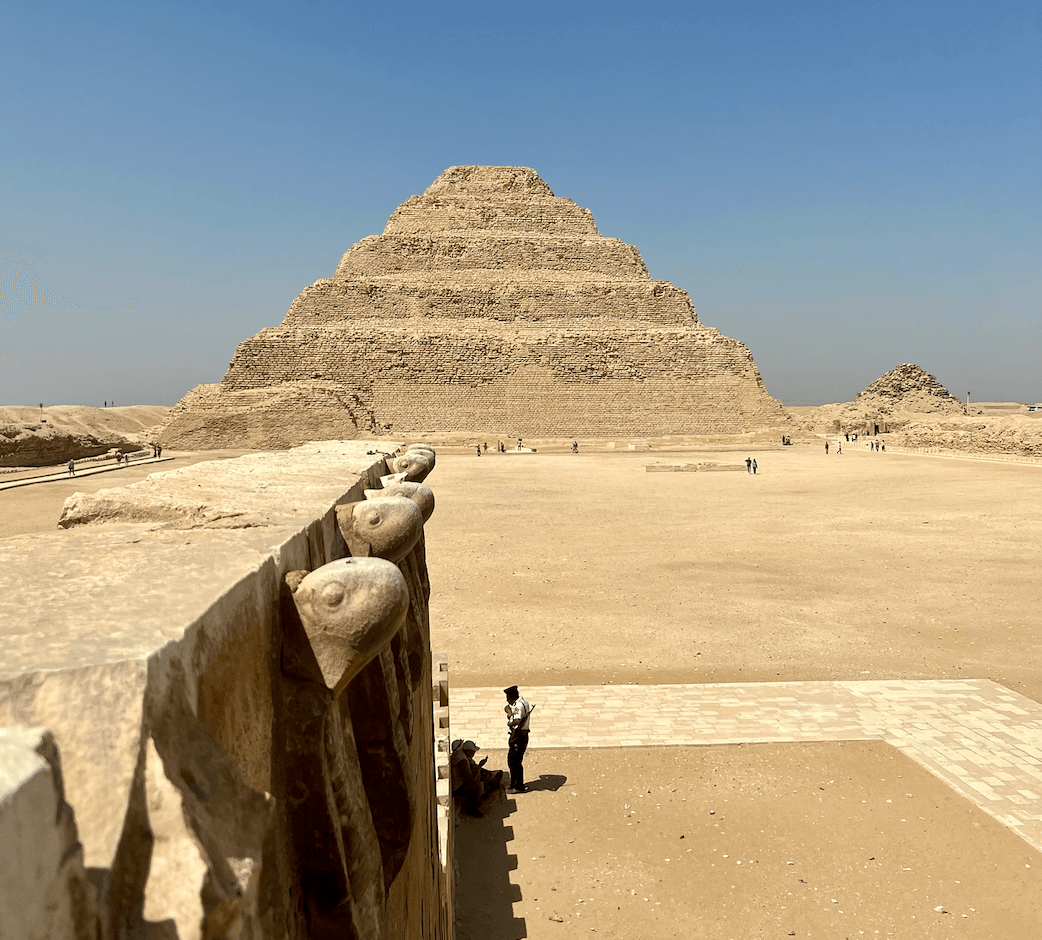
The First Attempts: From Mastabas to the Step Pyramid

Before pyramids existed, Egypt's earliest rulers were buried in flat, rectangular tombs called mastabas. These structures were simple, symbolic, and built primarily of mudbrick. The first major breakthrough came during the 3rd Dynasty, under Pharaoh Djoser, around 2,700 BCE. At Saqqara, Djoser's architect, Imhotep, attempted something revolutionary: stacking mastabas on top of one another to create height. The result was the Step Pyramid of Djoser — the first large-scale stone structure in human history. This was not yet a true pyramid, but it marked the moment when Egypt transitioned from symbolic tombs to monumental architecture. Today, visitors can explore the interior passages of this ancient wonder — watch our full walkthrough inside the Step Pyramid to experience the narrow corridors and burial chambers that have stood for over 4,700 years.
Early Failures: Meidum and the Cost of Ambition

As pyramid building evolved, pharaohs of the 4th Dynasty sought smoother, more elegant forms. One of the earliest attempts at a true smooth-sided pyramid was built for Pharaoh Sneferu at Meidum. Originally designed as a step pyramid and later converted into a smooth pyramid, Meidum suffered a catastrophic structural failure. Large sections collapsed, leaving behind the strange, tower-like shape we see today. Meidum taught Egypt's builders a crucial lesson: angle, weight distribution, and foundation mattered more than appearance. This failure did not stop Sneferu — it pushed him to try again.
Learning Through Error: The Bent Pyramid

Sneferu's next experiment took place at Dahshur, resulting in the famous Bent Pyramid. Midway through construction, the pyramid's steep angle proved unstable. Instead of abandoning the project, builders adjusted the angle partway up, creating the distinctive bent shape. This pyramid is one of the most valuable archaeological lessons in Egypt. It shows us ancient engineers actively responding to structural problems in real time — changing design to prevent collapse. The Bent Pyramid stands as physical proof that pyramid building was a process of learning, not a single moment of genius.
The Breakthrough: The Red Pyramid

Still under Sneferu, builders attempted one final time — and succeeded. The Red Pyramid, also at Dahshur, became Egypt's first successful true smooth-sided pyramid. With a lower angle and improved internal design, it finally achieved the balance between height, stability, and elegance. This pyramid became the direct architectural blueprint for what would come next.
Engineering Mastery: Inside the Pyramids

What made these pyramids stand for millennia was not just their external form, but their internal engineering. The corbelled gallery technique — where each successive layer of stone projects slightly inward — allowed builders to create massive internal chambers without the roof collapsing under millions of tons of stone above. This innovation, perfected over generations, remains visible today inside several pyramids that allow visitor access.
Perfection at Giza: Khufu's Great Pyramid

By the time Pharaoh Khufu began construction at Giza, pyramid building was no longer experimental. The Great Pyramid of Khufu represents the culmination of everything learned over generations — precise angles, internal chambers, stress-relieving architecture, and unmatched stonework. It remains the most perfectly constructed pyramid ever built. Khufu's pyramid did not appear out of nowhere. It exists because of Djoser's innovation, Sneferu's failures, and decades of trial and refinement. Khafre and Menkaure would follow, refining symbolism and scale, but the engineering foundation had already been perfected.
Why Most Visitors Miss the Full Story

Many travelers come to Egypt, see Giza, and leave believing they've "seen the pyramids." But in doing so, they miss: the birthplace of pyramid construction at Saqqara, the engineering failures at Meidum, the problem-solving at Dahshur, and the evolution that made Giza possible. The pyramids were not built in isolation — they were built through hundreds of years of learning. To experience the complete story of Egypt's pyramid evolution from first attempts to final mastery, explore our private tour options that visit all key sites including Saqqara, Dahshur, Meidum, and Giza across multiple immersive days.
Experience the Journey Yourself
Understanding pyramid construction is one thing — walking through the sites where it happened is another. From the Step Pyramid at Saqqara to the collapsed wonder at Meidum, from the bent experiment at Dahshur to the perfection at Giza, each site tells part of this epic story.