
When most travelers picture Egypt, they envision the towering pyramids of Giza, the golden treasures of Tutankhamun, or the colossal columns of Karnak Temple. These iconic sites rightfully earn their place on any Egypt itinerary, but they only tell part of the story. Just 60 miles north of Luxor lies my absolute favorite temple in all of Egypt, a site that somehow remains off most tourists' radar: the Temple of Dendera.

This stunning complex, dedicated to Hathor, the goddess of love, music, joy, and healing, offers something increasingly rare among Egypt's most famous sites: the chance to experience ancient grandeur without battling crowds, and to see colors and details so vivid you'll swear they were painted yesterday, not over two thousand years ago.
Why Most Tourists Miss This Hidden Temple in Egypt
Dendera's relative obscurity isn't due to any lack of magnificence. It's simply a matter of geography and logistics. Unlike other beautifully preserved Ptolemaic temples like Edfu and Kom Ombo, which sit conveniently along the Nile and can be easily visited during a river cruise, Dendera lies inland. Most Egypt tours beyond the pyramids follow a well-worn path: Cairo's pyramids and Egyptian Museum, a flight to Luxor for the Valley of the Kings and Karnak Temple, perhaps a Nile cruise stopping at temples right on the riverbank, then on to Aswan. Dendera doesn't fall into this convenient route. It requires a dedicated day trip from Luxor.
There's also a practical consideration: the road to Dendera requires government permission, which needs to be arranged through a qualified tour guide. This isn't complicated, but it does mean you can't just hop in a taxi on a whim. Working with a specialized tour operator ensures all the logistics are handled smoothly, so you can focus on the experience rather than the paperwork.
This combination of factors means Dendera remains one of Egypt's hidden gems. It's the kind of site that Egyptologists and seasoned Egypt travelers rave about, but that hasn't yet penetrated mainstream travel consciousness. And honestly? That's part of what makes it so special. While Karnak Temple sees thousands of visitors daily, you might share Dendera's vast hypostyle halls with just a handful of other travelers, giving you the space and silence to truly absorb the extraordinary atmosphere of this ancient healing sanctuary.
The Aura of a Healing Temple
There's something about Dendera that's difficult to put into words. From the moment you step through its entrance, the temple has an aura unlike any other site in Egypt. Maybe it's because this was a healing temple, a place where ancient Egyptians came seeking Hathor's power to cure illness and restore wellbeing. Maybe it's the way light filters through the halls, illuminating colors that shouldn't still exist after two thousand years. Or maybe it's the almost magical quality of the passageways: secret corridors carved into thick stone walls, narrow staircases that wind upward into darkness, and hidden chambers that make you feel like you've stumbled into an Indiana Jones film.

Walking through Dendera feels like stepping between worlds. The temple's energy is palpable, whether you attribute that to the centuries of ritual and prayer that took place here, to the architectural genius that created such an evocative space, or simply to the power of standing in a place of such profound historical significance. Every time I visit, I find myself drawn to just sit quietly in one of the halls, soaking in the atmosphere that no photograph can truly capture.
What Makes Dendera Temple Extraordinary: Beyond the Pyramids
The Best Preserved Temple Colors in Egypt

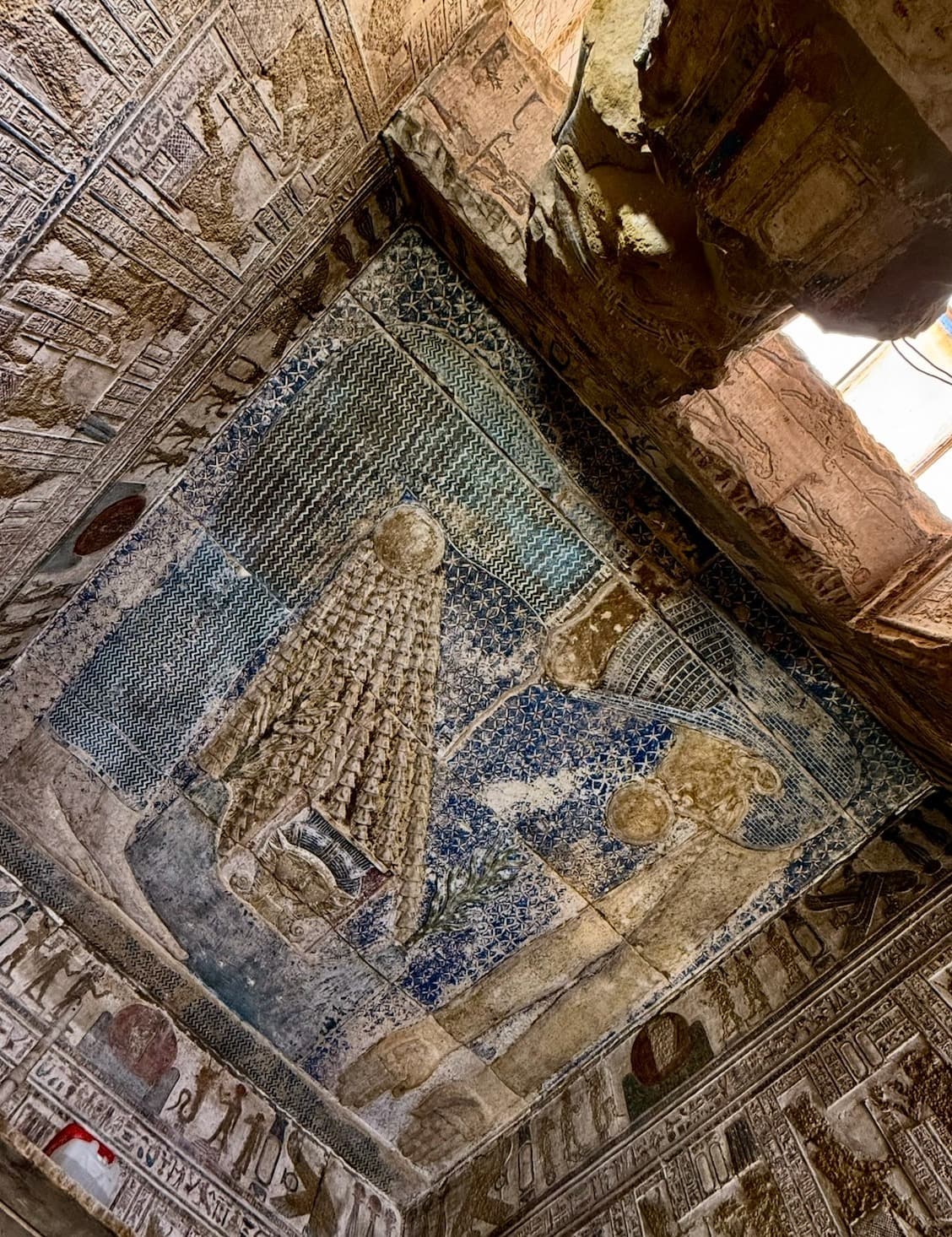
The first thing that strikes you at Dendera is the color. In most ancient Egyptian temples, you'll see faded traces of the brilliant pigments that once adorned every surface. At Dendera, entire ceilings glow with deep blues, vibrant reds, and rich golds that look impossibly fresh. The temple's excellent preservation (thanks to centuries of being buried under desert sand) means you're seeing these halls much as ancient worshippers did.
But it's not just that the colors survived. It's the way they transform the space. Standing beneath these painted ceilings, you understand viscerally why ancient Egyptians believed temples were gateways between the earthly and divine realms. The colors pull your gaze upward, draw you into the cosmic scenes playing out overhead, and create an atmosphere that's both intimate and infinite. I always tell people that if you can only see one temple ceiling in Egypt, make it Dendera's.
The Astronomical Ceiling at Dendera: Where Earth Meets Sky
The main temple's ceiling is nothing short of breathtaking. This isn't decorative art. It's a sophisticated astronomical document painted across stone, a map of the cosmos as ancient Egyptians understood it. The goddess Nut arches across the ceiling, her star-studded body forming the vault of heaven. Watch carefully and you'll see her swallowing the sun each evening and giving birth to it each morning, the eternal cycle of death and rebirth that governed Egyptian cosmology.
Surrounding Nut are constellations, planets, and protective deities, each precisely positioned. Ancient priests used these astronomical ceilings to track time, predict celestial events, and align temple rituals with cosmic rhythms. Standing beneath this painted cosmos, you're looking at the same sky chart that guided ancient astronomers over two millennia ago. Thanks to Dendera's remarkable preservation, you can see it in colors they would recognize. I've stood beneath this ceiling dozens of times, and each visit reveals new details I'd somehow missed before.
The Famous Dendera Zodiac: Egypt's Celestial Map

Dendera is home to one of ancient Egypt's most famous artifacts: the Dendera Zodiac, a stunning circular relief depicting the constellations and zodiac signs as they appeared in Ptolemaic Egypt. The original was removed in 1820 and now resides in the Louvre Museum in Paris (a loss that still stings), but a detailed replica has been installed in its original position in one of the temple's roof chapels.
Seeing the zodiac ceiling in context is essential to understanding what makes it so remarkable. This isn't purely Egyptian or purely Greek. It's a fascinating fusion created during the Ptolemaic period when Egypt was ruled by Greek pharaohs who presented themselves as legitimate successors to the ancient pharaohs. The zodiac blends traditional Egyptian astronomical symbolism with the twelve zodiac signs that Greek culture had adopted from Babylonian astronomy. It's a stone testament to the cultural exchange and synthesis that characterized Ptolemaic Egypt, proof that ancient civilizations were far more interconnected than we often imagine.
Secret Passageways and Hidden Chambers

Here's where Dendera gets truly magical, and honestly, where I always feel most like an explorer. Hidden within the temple's massive stone walls are narrow passageways and staircases that most visitors never even notice. These aren't grand processional routes. They're intimate, almost secret corridors that wind through the temple's structure like capillaries through a body.
The walls of these passageways are covered floor to ceiling with intricate reliefs showing religious processions, priests carrying sacred objects, and scenes of ritual. Climbing these ancient stairs, running your hand along walls carved over two thousand years ago, you can almost hear the footsteps of the priests who used these routes during festivals and ceremonies. The stone is smooth from centuries of hands touching it, a tangible connection to everyone who walked this path before you.
One stairway leads to the roof, where small chapels once hosted New Year ceremonies when Hathor's statue was carried up to be 'united with the sun disk.' Standing on that rooftop, looking out over the agricultural landscape that has changed remarkably little in two millennia, you can imagine those ancient processions winding up through the darkness to emerge into brilliant sunlight. It's one of those moments that makes you feel the weight of history in the best possible way.
Underground Crypts: Egypt's Most Mysterious Reliefs
If the secret passageways feel magical, the underground crypts feel genuinely otherworldly. These narrow chambers, carved deep beneath the temple, once stored sacred treasures and ritual objects. Today, visitors can descend into their dim, atmospheric corridors. It's an experience unlike anything else in Egypt. Fair warning: if you're claustrophobic, these tight spaces might challenge you, but they're absolutely worth it.
The crypts are covered with some of the most unusual and mysterious reliefs in all Egyptian art. One famous image shows large bulb-like forms emerging from lotus flowers, with serpents representing divine creative power. These have been fancifully interpreted as everything from ancient light bulbs to electrical devices, but they're actually djed pillars (symbols of stability associated with Osiris) rendered in a unique artistic style. Standing in the confined space of these crypts, surrounded by these enigmatic images, you understand why they've captured imaginations for centuries. I always bring a good flashlight down here. The details are worth seeing up close.
Cleopatra at Dendera Temple

For those fascinated by Egypt's most famous queen, Dendera offers something special: one of the few surviving contemporary images of Cleopatra VII. On the rear exterior wall of the temple, a large relief shows Cleopatra with her son Caesarion (fathered by Julius Caesar) making offerings to the gods.
It's not a realistic portrait. It's carved in the formal, idealized Egyptian style that had been used for millennia. But that's precisely what makes it so significant. Cleopatra, a Greek Ptolemaic ruler educated in Alexandria's cosmopolitan culture, chose to present herself here in purely Egyptian iconography, claiming her place in the unbroken line of pharaohs stretching back three thousand years. This relief places Dendera firmly in the dramatic final chapter of ancient Egyptian civilization, when the Ptolemaic dynasty was drawing to its close and Egypt was being drawn inexorably into Rome's orbit. I always make sure visitors see this relief. It's easy to miss if you don't know where to look.
Planning Your Day Trip from Luxor to Dendera Temple
How to Get to Dendera Temple from Luxor
Dendera is located approximately 60 kilometers (37 miles) north of Luxor, about an hour's drive through rural agricultural landscapes. Because the road requires government permission, you'll need to arrange your visit through a qualified tour operator who can handle the logistics. The drive itself offers a wonderful glimpse of contemporary Egyptian life beyond the tourist sites: villages, fields, farmers working land that's been cultivated for thousands of years. It's a reminder that Egypt isn't just ancient monuments. It's a living culture with deep roots.
Best Time to Visit Dendera Temple
Dendera is wonderfully uncrowded year-round, but the cooler months from October through March offer the most comfortable temperatures for exploring this off the beaten path Egypt destination. Unlike the Valley of the Kings or Karnak, where morning visits are essential to beat both heat and crowds, Dendera can be visited comfortably at various times of day.
That said, the quality of light really matters for experiencing those incredible painted ceilings. Late morning or early afternoon light tends to illuminate the interior halls most effectively, making the colors even more vibrant. I've found that around 10 AM to 1 PM offers the perfect combination of good light and comfortable temperatures, though honestly, Dendera is spectacular at any hour.
How Long to Spend at Dendera
Give yourself at least two to three hours at Dendera. This is not a site to rush through. Trust me, I've tried to do quick visits and always regretted it. You'll want time to explore the main temple thoroughly, including the rooftop chapels and underground crypts, to discover those magical passageways, and to simply stand beneath the cosmic ceiling and absorb the atmosphere.
Dendera rewards slow, contemplative exploration. Bring a flashlight (or use your phone's light) for the crypts and darker passageways. Take time to study the hieroglyphs and scenes covering every surface. Let yourself feel the energy of this ancient healing sanctuary. Some of my best memories here are from moments when I simply sat quietly in one of the halls, watching light move across the painted ceiling as the sun shifted.
Why Dendera Deserves a Place on Your Egypt Itinerary Beyond Cairo
The pyramids are awesome monuments to royal power and engineering ambition. The Valley of the Kings reveals intimate royal burial chambers. Karnak overwhelms with its sheer scale. But Dendera gives you something different entirely. It preserves not just the architecture but the atmosphere of ancient Egyptian temple life. The colors, the completeness, the secret passageways, the astronomical ceiling, the healing energy that still seems to permeate the space: all combine to create an experience that feels less like visiting a ruin and more like stepping back in time.
Dendera is accessible yet still feels like a discovery. It's not difficult to reach from Luxor (with proper arrangements), yet it doesn't appear on most standard Egypt tour itineraries. Including it immediately elevates your trip from a standard Egypt tour to something more thoughtful and personalized, a true Egypt itinerary off the beaten path. I've seen the look on travelers' faces when they first walk into Dendera, and it's always a mix of awe and gratitude that they made the effort to come here.
And for anyone interested in Egypt's later history (the Ptolemaic period, Cleopatra's era, the cultural fusion of Egyptian and Greco-Roman civilizations), Dendera is essential. Most tourists' Egypt experience focuses heavily on the Old and New Kingdoms. Dendera offers a window into an equally fascinating but often-overlooked chapter when Egypt's ancient traditions continued and evolved under Greek rulers who presented themselves as legitimate pharaohs.
Custom Egypt Tours That Include Lesser Known Ancient Sites
If you're planning an Egypt trip and feeling drawn to Dendera, the best approach is working with a tour operator who specializes in customized itineraries. At PyraVista, we design personalized Egypt journeys led by licensed Egyptologists who handle all the logistics (including those government permits) and who can provide the historical and cultural context that transforms sites like Dendera from impressive ruins into vivid stories of ancient lives and beliefs.
A well-designed custom Egypt itinerary might focus on Ptolemaic Egypt, including sites like Edfu Temple (another beautifully preserved Ptolemaic temple accessible by river cruise), the Greco-Roman sites of Alexandria, and the temples of Philae where ancient Egyptian religion survived into the Christian era. Or create an itinerary centered around Egypt's most spectacular but lesser-known temples in Egypt, giving you the space and time to truly experience each site without the typical tourist crowds. We've found that travelers who include Dendera often tell us it was their favorite day of the entire trip.
Frequently Asked Questions About Dendera Temple
Is Dendera Temple worth visiting?
▼
How do I get to Dendera Temple from Luxor?
▼
How long should I spend at Dendera Temple?
▼
What is special about Dendera Temple?
▼
Can you visit Dendera without a tour?
▼
Experience Dendera for Yourself
▼
Ready to design a personalized Egypt itinerary that includes hidden gems like Dendera? Contact PyraVista to work with our team of licensed Egyptologists who can craft a journey tailored to your specific interests and travel style.