
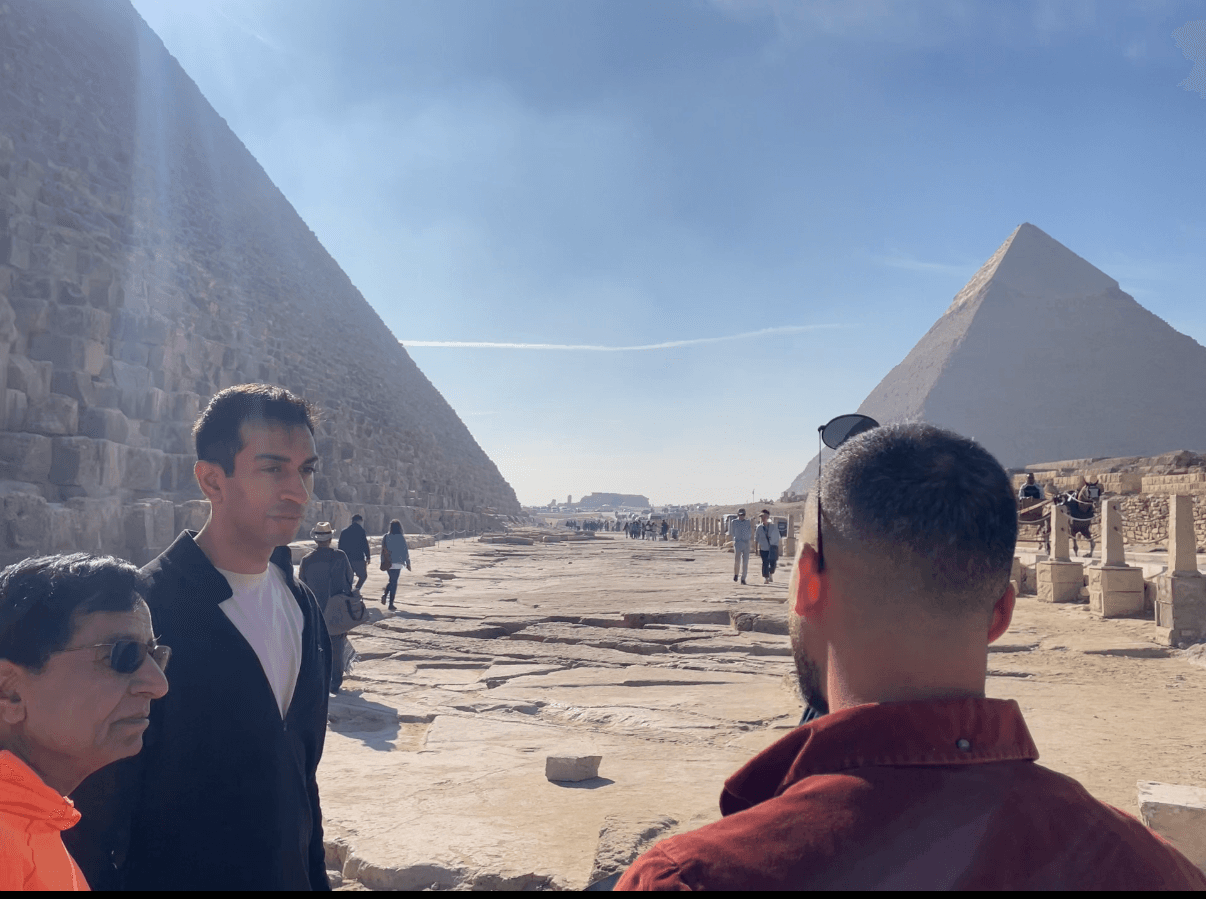
When I first planned my trip to Egypt, I kept putting it off. I had traveled to over 30 countries - explored the eastern parts of Turkey multiple times, wandered through India, climbed the pyramids in Mexico. I wasn't exactly a beginner traveler. But Egypt? I kept hesitating. When I searched online, I found mixed reviews. Some travelers raved about their experiences, others mentioned challenges with vendors and navigation. The uncertainty made me cautious. So I kept putting it off, even though ancient Egypt had fascinated me for years. When I finally booked my trip, I hedged my bets. Just three days. Enough to see the Pyramids of Giza and Saqqara, then back to Turkey. Looking back, that short trip was a mistake, but I did one thing absolutely right that changed everything. I hired an excellent tour guide and driver for all three days. That single decision transformed what could have been a frustrating experience into something magical.
Expert lead family tour at the pyramids of giza
The Short Answer: It Depends on What You Want
Not everyone needs a tour guide in Egypt. If you're staying at a beach resort in Sharm el-Sheikh, spending a weekend in modern Alexandria, or just passing through Cairo's airport, you can absolutely do it on your own. But if you're coming to Egypt to see the pyramids, explore ancient temples, or understand the incredible 5,000-year history carved into every stone, then yes, you need a guide. Not just any guide, but a good one. Here's why.
Why Egypt Is Not a DIY Destination (Even for Experienced Travelers)
I say this with complete respect for Egypt and its people: this is not entry-level travel. The transportation systems don't work intuitively for most visitors. Arabic is especially difficult compared to other languages. The culture, the unwritten rules, the way things operate - it's just not easy to understand as an outsider. And honestly, that's okay. Part of what makes Egypt fascinating is that it's deeply, authentically Egyptian. But it means that trying to do it yourself often leads to frustration, wasted time, and missed opportunities.
Understanding What You're Seeing
Here's what most people don't realize until they arrive: understanding Egyptian archaeological sites on your own is incredibly challenging. Walk through Karnak Temple without a guide and you're looking at towering columns covered in ancient inscriptions, statues of gods, and walls telling stories. Yes, there are some English signs at major sites, but they only give you basic facts. They can't explain the connections, the context, or the deeper meaning behind what you're seeing. Getting to sites like Dendera or Saqqara on your own is complicated, and even when you arrive, it's just way too much to understand without expert guidance. You won't get the full experience. Egypt's history spans 5,000 years. Without context, without someone who can connect the dots between different dynasties and time periods, you end up staring at rocks. With a knowledgeable guide, those rocks come alive with stories of pharaohs, religious beliefs, architectural innovations, and human drama that happened thousands of years ago.
The Vendor Situation
One of the questions many travelers have is about vendors at tourist sites. Yes, vendors do approach tourists at major sites, and it can feel overwhelming if you're not prepared. Here's what made a difference for me: my guide handled these interactions. He managed them in a subtle, respectful way that kept me comfortable. I didn't feel harassed, and I could focus on enjoying the sites rather than worrying about unwanted attention. A good guide helps you navigate these social situations smoothly, which makes your visit much more relaxing.
Transportation and Navigation
Cairo traffic is legendary. Getting from the pyramids to Saqqara to museums isn't intuitive if you don't know the area. Knowing which neighborhoods are safe, which routes avoid traffic, when to visit sites to avoid massive crowds - these things matter. A good guide and driver know all of this. You hit sites at optimal times with fewer crowds. You never sit in traffic longer than necessary. Time is precious when you've traveled halfway around the world for your Egypt trip.
When You Don't Actually Need a Guide
There are absolutely situations where you don't need a tour guide in Egypt: Visiting modern cities for business or leisure: If you're in Cairo or Alexandria for work or to experience contemporary Egyptian culture, you can navigate on your own just fine. Staying at a beach resort: Sharm el-Sheikh, Hurghada, Dahab are tourist-friendly resort areas where you don't need a guide. Very tight budget: If you're backpacking on $20 a day, hiring a private guide might not fit your budget. Group tours or DIY might be your only option. Very short stopover: If you're just in Cairo for a layover and want to see the city for a few hours, you can probably manage the basics alone.
But if you're coming to Egypt specifically for the ancient history, the temples, the tombs, the pyramids, then skipping a guide is like going to a symphony and wearing earplugs. You'll see it, but you won't experience it.
Not All Egypt Tour Guides Are Created Equal
Here's something critical to understand: there's a massive difference between types of guides in Egypt.
Regular Tour Guide vs. Licensed Egyptologist
Regular Tour Guides receive basic training, usually 1-3 months. They memorize scripts about major sites. They know the standard facts - when the pyramids were built, who the famous pharaohs were, basic information about each location. They're perfectly fine for basic sightseeing. Licensed Egyptologists have university degrees in Egyptology. They're licensed by Egypt's Ministry of Tourism. They understand the religious beliefs, the political systems, the architectural evolution, the connections between different periods of Egyptian history. They can answer your questions, even the complex ones you didn't know you had. The difference in experience is night and day. When you're standing inside the Great Pyramid, an Egyptologist can explain the mathematical precision of its construction, the religious significance of its orientation, the evolution from step pyramids to true pyramids, and why this particular pyramid was built the way it was. A regular guide tells you it was built by Khufu around 2560 BC. Both facts are true, but only one transforms your understanding.
The Real Cost of Cheap Tours
Let me address something that confuses a lot of travelers planning Egypt trips. You'll see one-day Cairo tours advertised online for incredibly low prices. I'm talking $30, $40, maybe $50 per person for a full day that includes the Pyramids of Giza, the Sphinx, and a museum visit, with a driver, guide, and all entry tickets included. Here's the thing: entry to the Grand Egyptian Museum alone costs $30-40 USD per person (depending on which ticket type and whether you want access to special areas like inside the pyramids). Add the Pyramids entry, transportation, guide fees, and you're already way over the advertised tour price. It's worth understanding that with very low-cost tours, the business model typically includes shopping components to subsidize the tour price.
How to Choose the Right Tour Guide for Egypt
If you've decided you want a guide (and I strongly recommend you do), here's what to look for:
Must-Haves:
- Licensed by Egypt's Ministry of Tourism: This is non-negotiable. Licensed guides have passed government requirements and are registered with official tourism authorities.
- Excellent English (or your language): You need to be able to ask questions and get clear answers.
- Transparent pricing with no hidden costs: If the price seems too good to be true, there's a catch.
- Reviews from past travelers: Look for specific reviews that mention knowledge, helpfulness, and professionalism.
- Customizable itineraries: Egypt isn't one-size-fits-all. Your guide should adapt to your interests.
The Two Types of Egypt Travelers
There are two types of people who visit Egypt: 1. Those who fall completely in love with the experience and want to return 2. Those who had an unpleasant, frustrating time and say they'd never go back The quality of the trip, the sites, the history - it's all the same. But the experience is completely different. And I genuinely believe the difference comes down to planning. Specifically, whether they had a good guide or tried to do it themselves. The travelers who DIY often encounter:
- Confusion about where to go and how to get there.
- Time spent navigating unfamiliar transportation.
- Frustration with language barriers.
- Need to manage vendor interactions.
- Missing context for what they're seeing.
The travelers with good guides experience:
- Seamless logistics and transportation.
- Sites timed to avoid peak crowds.
- Deep understanding of what they're seeing.
- Comfortable navigation of social situations.
- Confidence throughout the trip.
Same country. Different experience. All because of preparation.
Should You Book Your Guide Before Arriving in Egypt?
Yes. Absolutely yes. The best Egyptologist guides book up months in advance, especially during peak season (October through April). If you show up in Cairo hoping to find a great guide on the spot, you'll likely end up with whoever is available, not who is best. Plus, booking in advance means you can research, read reviews, ask questions, and feel confident about who you'll be spending your days with. For single-day tours like Cairo highlights, you can sometimes book just a few days ahead. But for multi-day tours or travel during peak season, book at least 2-3 months in advance if possible.
Frequently Asked Questions About Egypt Tour Guides
Can I visit the Pyramids of Giza without a guide?
▼
Is it safe to travel in Egypt without a tour guide?
▼
What's the real difference between an Egyptologist and a regular tour guide?
▼
Can I hire a guide for just one day instead of my whole trip?
▼
Do I need a different guide for each city in Egypt?
▼
My Final Recommendation
▼
Is Egypt worth visiting? Absolutely.