
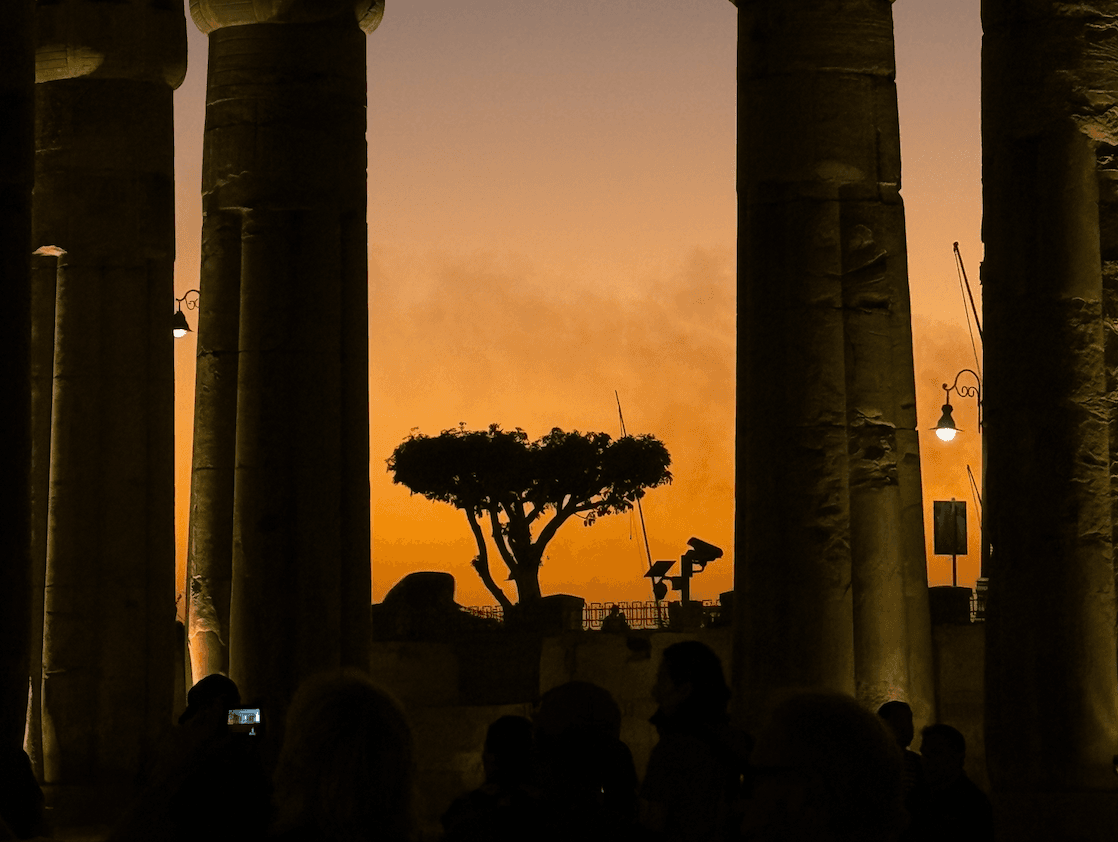
On August 2, 2027, a total solar eclipse will cast its shadow across Egypt for 6 minutes and 23 seconds: the longest totality anywhere on Earth until the year 2114. This celestial event will pass directly over Luxor's ancient temples, the same monuments where Egyptian astronomers tracked the heavens 4,000 years ago. The alignment is extraordinary. The civilization that first calculated the 365-day year and mapped star patterns with mathematical precision will host the century's most spectacular eclipse. For travelers who appreciate both astronomical phenomena and ancient history, this represents a once-in-a-lifetime convergence.
Ancient Egypt's Sophisticated Understanding of Eclipses
The ancient Egyptians didn't view eclipses as random acts of divine anger. They were systematic astronomers who observed, recorded, and predicted celestial events with remarkable accuracy.
The Cairo Calendar: Evidence of Eclipse Prediction
The Cairo Calendar, a papyrus dating to approximately 1200 BCE, demonstrates that Egyptian priests tracked 'lucky' and 'unlucky' days based on astronomical observations. While some scholars initially dismissed this as superstition, closer analysis reveals a pattern: the 'unlucky' days correspond to dates when eclipses occurred or could potentially occur based on lunar cycles. The Egyptians understood the Saros cycle: the 18-year, 11-day pattern that governs eclipse repetition. This knowledge required centuries of meticulous observation and record-keeping across generations of priest-astronomers.
Temple Architecture as Astronomical Instruments

Egyptian temples weren't just places of worship. They were sophisticated astronomical observatories built with mathematical precision. The Temple of Karnak in Luxor features an axis aligned to the winter solstice sunrise. The Great Temple of Abu Simbel, 280 kilometers south, was engineered so sunlight penetrates its inner sanctum only twice per year: on dates believed to be Ramesses II's birthday and coronation. These alignments required advanced understanding of:
- The Earth's axial tilt and its effect on sun position
- The difference between sidereal and solar time
- Long-term astronomical cycles spanning decades
The Dendera Zodiac: Mapping the Night Sky

The Dendera Temple complex, 60 kilometers north of Luxor, contains one of ancient Egypt's most sophisticated astronomical artifacts: a circular star map carved into the ceiling of a chapel dedicated to Osiris. The Dendera Zodiac, dating to approximately 50 BCE, depicts:
- All twelve zodiac constellations
- The five visible planets (Mercury, Venus, Mars, Jupiter, Saturn)
- 36 decanal stars used to measure night hours
- A solar eclipse representation, shown as a hybrid creature combining sun and moon symbology

Solar Eclipses in Egyptian Mythology and Record
The ancient Egyptians conceptualized solar eclipses as the celestial serpent Apophis attempting to swallow Ra, the sun god, during his daily journey across the sky. But beneath this mythological framework lay practical astronomical knowledge. Hieroglyphic texts from the Middle Kingdom (2040-1782 BCE) reference 'the day the sky became dark at noon': descriptions consistent with total solar eclipses. The Turin Papyrus, a king list dating to Ramesses II's reign, marks certain dates with symbols indicating astronomical anomalies that modern calculations confirm coincide with historical eclipses. The priest-astronomers at Karnak Temple maintained observation records spanning centuries. They understood that eclipses followed predictable patterns, occurring when the moon crossed the sun's path at specific intervals. This knowledge was considered sacred: reserved for the educated elite who could read the heavens and advise the pharaoh.
Why Egypt Offers Exceptional Eclipse Viewing Conditions
Modern astronomers planning for the 2027 eclipse have reached the same conclusion ancient Egyptians did thousands of years ago: Egypt's climate and geography create ideal conditions for celestial observation.
Climate Advantages: Clear Skies When It Matters Most
Egypt in early August offers what astronomers call 'eclipse-favorable weather':
- Less than 5% average cloud cover in Luxor during August
- Negligible humidity (typically 20-30%) means minimal atmospheric distortion
- Stable atmospheric conditions with minimal turbulence for photography
- Consistent weather patterns: August is firmly in Egypt's dry season with virtually zero precipitation
The Path of Totality: Where Shadow Meets History
The 2027 eclipse path crosses North Africa from west to east, but Egypt offers the optimal combination of totality duration and accessible infrastructure. The path of totality will cross:
- The Red Sea coast near Hurghada
- Luxor and the Valley of the Kings
- Areas north of Aswan
- The Western Desert
What Makes the 2027 Eclipse Historically Significant
Eclipse enthusiasts (the community of 'umbraphiles' who travel globally to witness totality) are already marking August 2, 2027, as essential viewing.
Duration: Won't Be Matched Until 2114
The 6 minutes 23 seconds of totality available in Luxor represents the longest totality anywhere on Earth for the next 87 years. The next eclipse offering comparable duration won't occur until April 2114: four generations from now. Statistics:
- Average totality duration: 2-3 minutes
- 2024 North American eclipse maximum: 4m 28s
- 2026 Spain eclipse maximum: 2m 18s
- 2027 Egypt maximum: 6m 23s
- Next 6+ minute eclipse: April 18, 2114
Planning Your Eclipse Experience: What You Need to Know
If you're considering traveling to Egypt for the 2027 eclipse, here's what experience teaches about eclipse chasing:
Booking Timeline: Why Early Planning Matters
Total solar eclipses create concentrated demand in narrow geographic zones. The path of totality is typically 100-150 kilometers wide, channeling millions of potential viewers into limited areas. For the 2017 North American eclipse, hotels within the totality path sold out 12-18 months in advance. Prices in totality zones increased 300-400% above normal rates. Last-minute travelers settled for partial viewing locations or paid premium prices for whatever remained. For Egypt 2027, expect similar dynamics:
- Luxor hotel inventory is finite
- International eclipse chasers will book early
- Quality viewing locations require advance logistics
- Group tours will reserve space 12-24 months ahead
Why Guided Eclipse Tours Provide Value
First-time eclipse viewers consistently underestimate logistics complexity: Optimal positioning: Not every location within the totality path offers equal viewing. Elevation, horizon obstructions, urban light pollution, and crowd management all affect experience quality. Guides who've scouted locations provide advantage. Timing precision: Totality begins and ends at exact calculated times. Being 10 minutes late means missing it entirely. Being in the wrong location by 50 kilometers means experiencing shorter totality or none at all. Professional logistics eliminate these risks. Local expertise: Egypt requires navigation of customs, transportation, site access, and cultural protocols. Guides handle complexity, allowing you to focus on the astronomical experience. Historical integration: A guide can connect the astronomical event to the ancient Egyptian astronomical legacy, bringing meaning to witnessing totality from the same temples where priest-astronomers tracked celestial cycles 4,000 years ago.
Experiencing Totality: What the Ancient Egyptians Witnessed
If you've never experienced a total solar eclipse, no description fully captures it. But here's what to expect:
The Progression to Totality
First contact (approximately 1 hour before totality): The moon's edge touches the sun's disk. Through eclipse glasses, you watch a dark circle begin its path across the sun's face. Partial phase (90% coverage): The light takes on an unusual quality: still bright enough to see normally, but with a silvery, directional character unlike any natural lighting you've experienced. 95-99% coverage: The difference between 99% and 100% coverage is the difference between day and night, literally. Shadow bands (1-2 minutes before totality): Rippling shadows race across light-colored surfaces: walls, sand, fabric, like waves on water. The approaching shadow: Look west. A wall of darkness races toward you at 2,000+ kilometers per hour: the moon's shadow cone approaching at supersonic speed. Second contact (totality begins): The sun disappears. The sky transforms instantly to deep twilight. The corona bursts into view: the sun's outer atmosphere, a billion times fainter than the photosphere, suddenly visible in exquisite detail. 360-degree sunset colors ring the horizon. Temperature drops noticeably. Totality (6 minutes 23 seconds at Luxor): You can look directly at the eclipse without eye protection. The corona extends outward in irregular streamers. At the sun's edge, solar prominences (massive arcs of plasma) glow red-pink against the black disk. This is what ancient Egyptian astronomers witnessed. Third contact (totality ends): A brilliant point of light erupts at the sun's edge: the diamond ring effect as the photosphere re-emerges. Totality is over. Eclipse glasses go back on. The shadow races eastward.
Why Location Matters: Luxor's Unique Context

Experiencing totality from Luxor adds layers of meaning: You'll stand where Egyptian astronomers stood, tracking the same celestial mechanics they understood. The temples around you were built by people who calculated star positions, predicted planetary movements, and recognized eclipse cycles. When totality blankets Karnak Temple, you're witnessing the same phenomenon that ancient priests recorded, interpreted through mythology, and incorporated into their sophisticated astronomical models. The convergence of ancient astronomical knowledge and modern eclipse science creates resonance that viewing from a random field cannot match.
Conclusion
The numbers define the opportunity:
- 6 minutes 23 seconds: longest totality until 2114
- 87 years: time until the next comparable eclipse
- 96%: probability of clear skies in Luxor in August
- 4,000 years: legacy of Egyptian astronomical observation at these sites